
 409-842-4404
Weld Test Coupons: Faster Pipe Prep for Welding Programs
Key Takeaways
- Every pipe test joint needs two clean, matching bevels, so coupon prep grows with every booth and class you add.
- Torch and grinder prep costs arc time, consumables, and consistency, and thermal cuts still need grinding before welding.
- Compare your cost per coupon (pipe, prep labor, discs, and gas) against the delivered price of pre-beveled coupons.
- Start with booth count, since beveled ends per week drives the equipment decision.
- Check coupon diameter, wall thickness, and shop power before you budget for a beveling machine.
Weld test coupons are short pieces of pipe or plate that students weld for practice and for qualification tests. On pipe, two coupons butt together to make one test joint, and each end that meets in that joint needs a clean, matching bevel before anyone strikes an arc. Multiply that by every booth and every class, and coupon prep can take hours each week that should go to welding.
This guide is for welding instructors, program directors, and union training coordinators. It covers what a test-ready coupon needs, what hand prep costs, the make-vs-buy math, and what to look for in a beveling machine that can keep up with your booths.
What Is a Weld Test Coupon?
A weld test coupon is a sample joint made to be inspected. Practice coupons build arc time and technique. Test coupons prove a welder can follow a procedure. Under ASME Section IX, for example, the welder makes the test coupon following a qualified welding procedure specification (WPS), the finished weld is examined visually, and then it is either cut into bend test specimens or examined with radiography.
The procedure sets the details that matter for prep and fit-up: pipe size, wall thickness, bevel angle, land, and root opening. Coupon size matters for the qualification too. In ASME Section IX, the diameter of the test coupon sets the smallest pipe diameter a welder qualifies to weld, so the coupons you stock should match the tests your students are working toward.
What a Test-Ready Pipe Coupon Needs
A student’s grade should reflect their welding, so the prep they’re handed needs to be right. A coupon that’s ready for the booth has:
- A square, clean cut. The end should be square to the pipe so the two halves meet evenly all the way around.
- The bevel your procedure calls for. For butt welds in process and pressure piping, ASME B16.25 sets a 37.5 degree bevel on walls up to 0.88 inch, which forms a 75 degree included angle when two ends meet. Line pipe work commonly uses 30 degrees. Our guide to pipe bevel angles covers the differences.
- A consistent land. The land, or root face, is the small flat at the inside edge of the bevel, and on production piping ASME B16.25 calls for 1/16 inch, plus or minus 1/32 inch. Whether your students file their own land or get it machined, it needs to be even all the way around. If it varies, the root pass can burn through in one spot and fall short of full penetration in another.
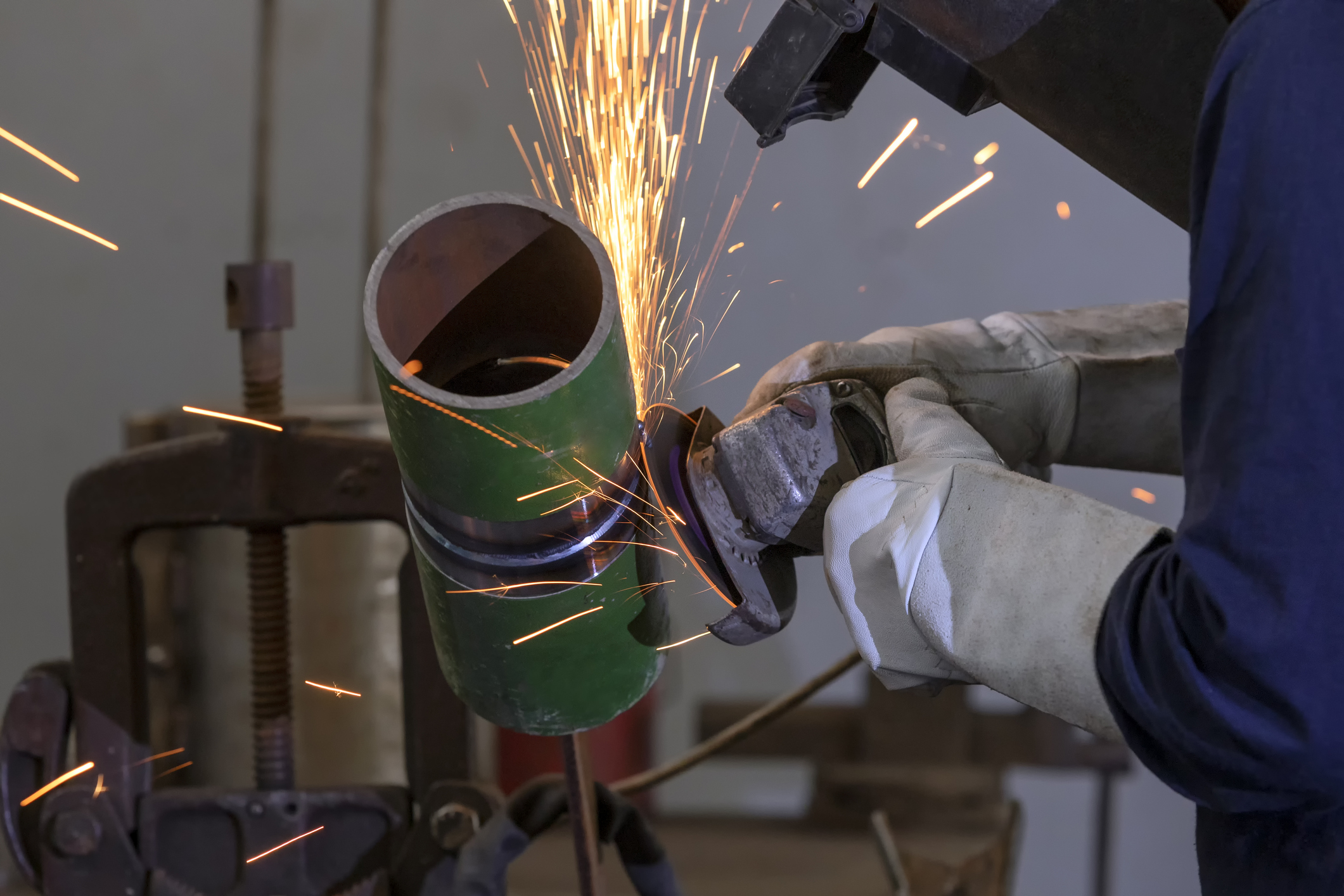
- Clean, sound metal. Torch and plasma cuts leave slag, oxide, and a heat-affected edge that has to be ground off before welding, so a thermally cut coupon isn’t ready until someone grinds it.
- Matching halves. When both coupons in a joint carry the same angle and land, the root opening stays even, and students spend their time welding instead of fighting the fit-up.
For more on land, root gap, and included angle, see our step-by-step guide on how to bevel a pipe.
What Torch and Grinder Prep Really Costs
Many programs still bevel coupons with an oxy-fuel torch or plasma cutter and finish them with a grinder. Those tools are already in the shop, so their cost is easy to miss. It shows up in other places:
- Lost arc time. Every minute a student spends grinding a bevel is a minute they aren’t welding. Across a full class and a full semester, those minutes add up.
- Inconsistent joints. A grinder drifts as it works around the pipe, so the angle and land change from one side of the coupon to the other and from one coupon to the next.
- Consumables and gas. Grinding discs, flap wheels, and cutting gases are recurring costs that rise with every coupon you prep.
- Shop safety. Sparks, heat, fumes, and grinding dust add risk in a room full of new welders.
Don Stunkel, training coordinator at UA Local 501 Plumbers & Pipefitters, summed up the payoff: “We expect this machine to pay for itself in saved time, pipe, and gases in under 2 years.” For a broader look at the numbers, see our comparison of machine vs. manual pipe beveling.
Should You Buy Pre-Beveled Coupons or Cut Your Own?
Buying pre-cut, pre-beveled coupons is the simplest option. You skip the equipment and the prep labor, and welding suppliers sell common sizes, such as 2-inch and 6-inch Schedule 80, ready to weld. The tradeoffs are the price per piece, freight, and waiting on stock when a class goes through more coupons than you planned.
Cutting your own from full-length pipe can lower the cost per coupon at volume, but only if prep is fast and consistent. Run the numbers with your own prices:
- Coupons per length. Divide the pipe length by your coupon length plus saw kerf. A 20-foot length is 240 inches, so 6-inch coupons yield a little under 40 pieces once you allow for kerf and squaring the ends.
- Material cost per coupon. Divide what you pay for the length by the number of coupons it yields.
- Prep cost per coupon. Multiply your prep minutes per coupon by your labor rate, then add discs, gas, and tooling.
- Delivered price. Compare that total to what a pre-beveled coupon costs you, including freight.
When prep takes minutes per end, buying often makes more sense. When prep takes seconds, cutting your own tends to come out ahead, and you control the sizes, schedules, and quantities.
Start With Your Booth Count
Before you price equipment, figure out how many beveled ends your shop needs in a week. Each test joint uses two coupons, and each coupon needs a beveled end where the two meet.
Say you run 20 booths and each booth turns out two test joints a week. That’s 40 joints and 80 beveled ends, before you count practice coupons. If hand prep takes 10 minutes an end, that’s more than 13 hours of grinding every week.
On a machine, the math changes. The C8H ChamferMate normally cycles in under 20 seconds, so 80 ends comes to under half an hour of cutting time, plus loading and unloading.
What to Look For in a Coupon Beveling Machine
- Capacity for your heaviest coupon. Size the machine to the largest diameter and heaviest wall you run. In MSI’s ChamferMate lineup, the hydraulic C5H bevels heavy-wall pipe up to 4-1/2 inches, and the C8H handles 1-inch up to 8-inch pipe. MSI lists the C8H as its premier machine for super heavy wall coupons.
- Repeatable setup. Every coupon should come off the machine with the same bevel and land. The C5H and C8H use an adjustable cutter head with interchangeable carbide inserts set with digital calipers, plus interchangeable grips for different pipe sizes.
- Cold cutting. A carbide-tooled machine cuts the bevel without heat, so there’s no heat-affected zone to grind off before welding. The C5H and C8H machine the weld bevel and face the pipe square.
- Tool life you can plan around. Standard C8H tooling typically lasts several hundred to several thousand cycles before replacement, depending on the material and wall thickness.
- Simple, safe operation. Students and lab aides need to be able to run it. ChamferMate machines have a totally enclosed cutting area, and the C5H and C8H use hydraulic clamping and feed.
- Your shop’s power. Check this before you budget. The C3A and C5A can be built for 240-volt single-phase power at additional cost, but the C5H and C8H are not available in single phase.
- A stationary machine built for the shop. Our ChamferMate machines aren’t portable. You bring the pipe to the machine and clamp it in place. That setup is what makes our automated pipe beveling machines many times faster than portable beveling units.
How Welding Programs Use ChamferMate Machines
MSI was established in 1992 and build our machines in Beaumont, Texas. Our ChamferMate pipe bevelers are used by trade schools and union apprentice programs that go through coupons in volume. The C8H is a top choice for UA apprenticeship programs, trade schools, and community colleges preparing weld test and training coupons.
A manager at one union apprentice program described the change after buying a C8H: “Since purchasing the C8H from MSI we have seen a tremendous increase in test coupon quality with cleaner edges, while producing the pipe bevel samples in far less time for significantly less money.”
When you call MSI, you talk to a real person in Beaumont with years of experience. As one welding instructor at Greenville Technical College put it, “This company has FANTASTIC customer service!”
Get a Quote for Your Coupon Prep
Tell us your coupon sizes and schedules, how many coupons you prep in a typical week, and what power your shop has. Our engineers will point you to the right ChamferMate and send a quote. You can request a quote online or watch the machines run in our video library.