
 409-842-4404
 How to Bevel a Pipe for Welding: Methods & Tools
Key Takeaways
- A good pipe bevel creates a consistent angle, land, and root gap, which is what gives you full weld penetration and keeps joints from failing X-ray.
- Hand grinding is cheap and portable but slow, dusty, and prone to uneven, error-filled joints.
- Thermal cutting is fast but leaves a heat-affected zone (HAZ) that usually has to be ground off before welding.
- Cold-cut machines (ID and OD mounted) give the best precision, with repeatable results, no dust, and no HAZ.
- Heavy-wall pipe needs a heavy-duty machine, since hand methods are slow and inaccurate on thick walls.
A fabricator’s guide to beveling pipe faster and safer
To bevel a pipe for welding, you cut an angled edge (usually 37.5 degrees) on the pipe end so the weld can penetrate the full wall thickness. A weld is only as good as the joint prep behind it. When a bevel is inconsistent, the root gap moves around, the filler metal does not penetrate evenly, and the joint can fail its X-ray. A good bevel gives every joint the same repeatable foundation, which is what a sound weld depends on.
You can bevel a pipe three ways: hand grinding, thermal cutting with a torch or plasma, or machining with a cold-cut beveling machine. Whether you are handling a quick field repair or running a high-volume shop, the method you pick drives your cycle times, operator safety, and cost. This guide looks at all three, and walks through how to bevel a pipe with a machine step by step.
What does it mean to bevel a pipe for welding?
Pipe beveling means cutting an angle on the end of a pipe or tube to prepare it for welding. If you butt two square-cut pipes together and weld them, the weld only fuses the outside surface. Cutting an angle on the edges opens a channel that lets the weld bead penetrate the full thickness of the wall.
Under AWS joint design practice, the common target for a V-groove weld is 37.5 degrees on each end, which gives a 75-degree included angle when the pipes meet. You also need a consistent land (the flat, unbeveled strip at the root) and a steady root gap. Hit those and you avoid poor fit-up, rework, and rejected welds.
Method 1: Hand grinding a pipe bevel
For decades the default has been the angle grinder with a grinding disc or flap wheel. The operator works the pipe edge down by hand until the angle looks right.
The upside is access and cost. Grinders are cheap, portable, and on every job site, which makes hand grinding workable for a single light-duty repair on thin-wall pipe.
The downside shows up fast in production. It depends entirely on the operator’s hand, so you get uneven lands and inconsistent angles. It also throws hazardous dust and exposes workers to vibration and strain. The slow cycle times and the risk of a failed joint make hand grinding an expensive habit, not a shortcut.
Method 2: Thermal cutting (oxy-fuel and plasma)
When a grinder is too slow, many crews reach for a torch. Oxy-fuel and plasma cutters, sometimes on a track system, slice the pipe at an angle.
Thermal cutting is fast, especially on standard carbon steel. A mechanized torch can travel a pipe in a fraction of the time it takes to grind the same joint.
The catch is the heat-affected zone (HAZ). The intense heat changes the metallurgy at the pipe edge and can leave it hard and brittle. Because welding codes control joint metallurgy, you almost always have to follow up with a grinder to clean the HAZ off before welding. In practice, thermal cutting trades one manual step for another.
Method 3: Cold-cut pipe beveling machines
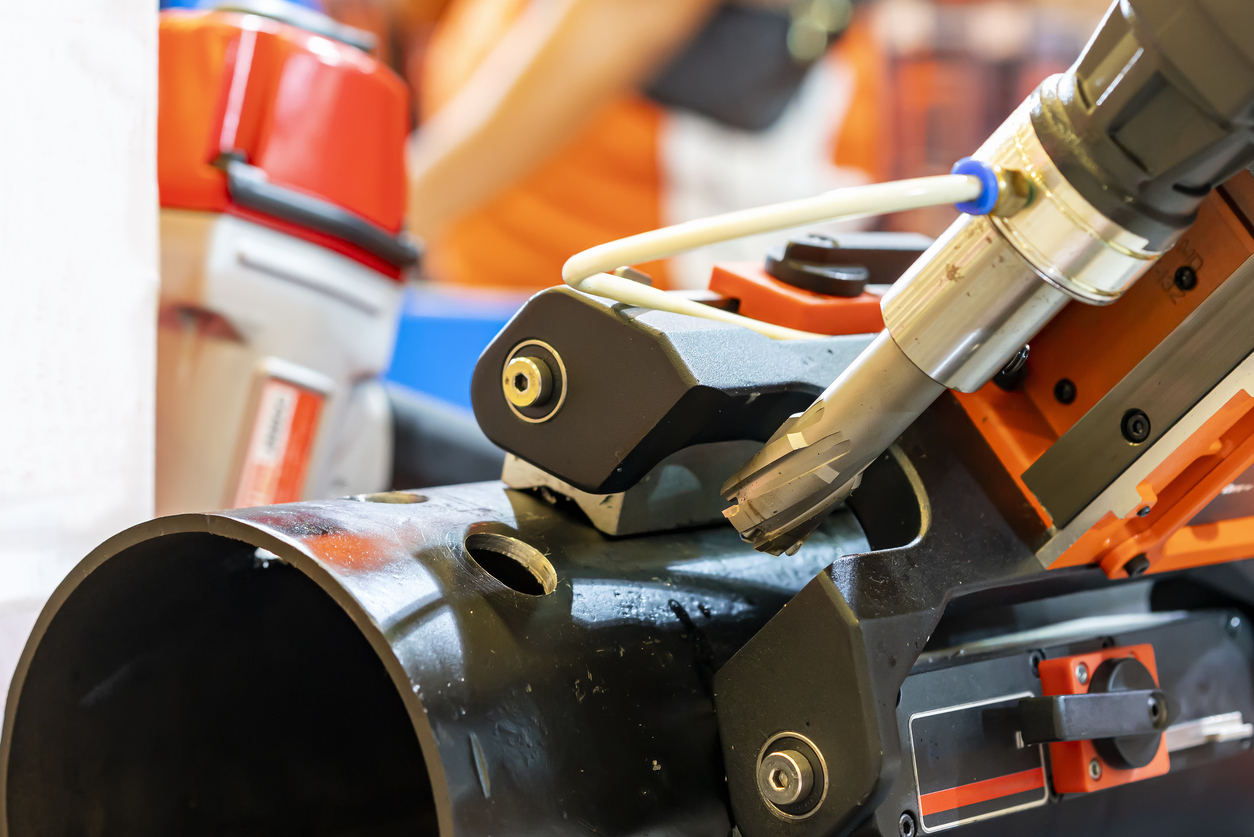
When you need precision, safety, and speed together, the answer is mechanical beveling. These machines use high-speed steel or carbide bits to shave metal from the pipe edge.
Because they cut with a tool instead of heat or friction, the process is called cold cutting. Cold-cut machines make no dust, leave no HAZ, and are far easier on the operator. Most importantly, they repeat. Once it is set, the machine makes the same flat land and exact angle on every pipe, which nearly eliminates poor fit-up and X-ray failures.
Machines are grouped by how they grip the pipe. Inside diameter (ID) machines use an expanding mandrel inside the pipe to self-center the cut. Outside diameter (OD) machines, or clamshells, clamp around the outside, which works well for inline cutting and beveling where the pipe ends are hard to reach.
How to bevel a pipe with a machine, step by step
Moving from hand tools to a machine changes the workflow. Steps vary by model, but here is the basic process on an ID-mounted machine:
- Measure and pick tooling. Measure the pipe’s inside diameter and choose the right mandrel and the cutting bits for your angle (for example, 37.5 degrees).
- Mount the machine. Slide the mandrel into the pipe and tighten the draw nut. The jaws expand against the inside wall, locking the machine in place and centering the cutting head.
- Align and feed. Start the air or electric motor, then advance the feed handle slowly to bring the bit into the edge. Keep a steady feed so the tool peels off metal ribbons instead of making dust.
- Check the face. Once the land is formed and the bit reaches depth, back the tool out, power down, and verify the angle and land.
How to bevel heavy-wall pipe
Standard methods fall apart on heavy wall. Once the wall passes about half an inch, hand grinding becomes an hours-long job that almost guarantees an uneven joint, and thermal cutting on thick alloy adds a lot of heat and a bigger HAZ.
Heavy wall needs rigid machine tooling made for deep, steep cuts. Heavy-duty ID and OD machines use reinforced gearboxes and multi-point heads that can face, bevel, and counterbore thick carbon or alloy steel in one setup. With the right machine, a four-hour hand-grinding job can drop to a roughly ten-minute machine cycle.
Standard Pipe Bevel Angles
The bevel angle is measured from a line perpendicular to the pipe axis, not from the pipe wall. Two beveled ends fitted together give you the included angle, and that is the figure your welding procedure actually calls out.
37.5 Degree Bevel (75 Degree Included Angle)
This is the standard single-V butt weld prep for process and pressure piping, called out in ASME B16.25. If a drawing specifies a pipe bevel without naming the angle, this is almost always what it means. It opens the groove wide enough for the welder to work the root without asking you to fill more void than the joint needs.
30 Degree Bevel (60 Degree Included Angle)
Common in structural work and general fabrication. The narrower included angle takes less filler metal and fewer passes than a 37.5 degree prep, but it also leaves the welder less room to reach the root. It shows up more often on plate and structural members than on pressure piping.
J-Bevel
Instead of one straight angled face, a J-bevel cuts a curved groove with a small radius at the root and a near-vertical wall above it. It removes far less material than a straight V on the same wall thickness, which cuts filler metal, arc time, and distortion. On heavy wall pipe it is usually the right answer.
Compound Bevel
A compound bevel puts two angles on the same face, a steeper one down near the root and a shallower one above it. Same logic as the J-bevel: open the groove only where the arc actually needs room and leave the rest of the wall alone.
Above roughly 3/4 inch wall, a straight V starts costing real money in filler metal and arc time. That is where most shops move to a J-bevel or a compound bevel. The tradeoff is that both profiles are difficult to hold consistently with a grinder, which is why heavy wall prep usually ends up on a machine.
Bevel Terminology: Land, Root Gap, and Included Angle
Most weld prep rejections come down to one of three dimensions. Your welding procedure specification will call out all three, and a fitter or inspector will check all three.
Land (Root Face)
The land is the flat, unbeveled strip left at the inside edge of the bevel, running around the bore of the pipe. It is typically 1/16 inch, held to about plus or minus 1/32 inch. The land gives the root pass something to fuse into. Too little and you burn through. Too much and the root does not fully penetrate.
Root Gap (Root Opening)
The root gap is the space between the two land faces once the joint is fit up. It usually runs 1/16 to 3/32 inch depending on the process and the procedure. The gap lets the arc reach the full thickness of the land so the root pass fuses both sides instead of bridging across the top.
Included Angle
The included angle is the total opening of the groove once both ends are fitted, so two 37.5 degree bevels give a 75 degree included angle. It has to be wide enough for the electrode or torch to reach the root without excessive weaving, and narrow enough that you are not filling a bigger void than the joint needs.
Why These Three Dimensions Are Hard to Hold by Hand
A grinder removes material based on how the operator holds it. The angle drifts as you work around the circumference, the land goes from thick on one side to nothing on the other, and no two ends come out the same. On a single joint that is manageable. Across a production run, or on a weld test coupon that is going to be sectioned and inspected, it is not. A machined bevel holds the angle and the land to the same dimension on every cycle because the tooling sets them, not the operator.
Upgrading your weld prep with MSI
The decision to upgrade comes down to simple math. Weigh the cost of the machine and tooling against what you spend now on abrasive wheels, labor hours lost to slow grinding, and the painful cost of cutting out and redoing a ruined heavy-wall weld.
A good rule is to scale your method to wall thickness and weekly output. If you are prepping dozens of pipes a week or working with anything heavier than Schedule 40, a machine is the defensible choice. Manufacturing Solutions Industries (MSI) builds durable, USA-made beveling machines that are simple to run, many on a single foot pedal, so your crew gets clean, repeatable prep without long training. Tell us about your pipe and your output, and we will help you spec the right machine. Request a quote from MSI to get started.