
 409-842-4404
Stud Bolt Marking Requirements: B7, B8M, L7 and 2H
Key Takeaways
- ASTM A193 and A320 studs 3/8 inch and larger need the grade symbol and manufacturer’s identification on one end, and the two can be split across both ends if one end is too small.
- Every ASTM A194 nut needs the grade and maker’s mark on one face, whatever the size, with a B added for nuts machined from bar stock.
- Current editions of A193 no longer require a line under B7M, but the line is still permitted, so B7M shows up both ways.
- Strain-hardened Class 2 stainless studs carry SH after the grade under A193, as in B8SH and B8MSH.
- A320 bolting impact tested at a nonstandard temperature has to be marked with the reported test temperature, and impact-tested grade 7 nuts are marked 7L.
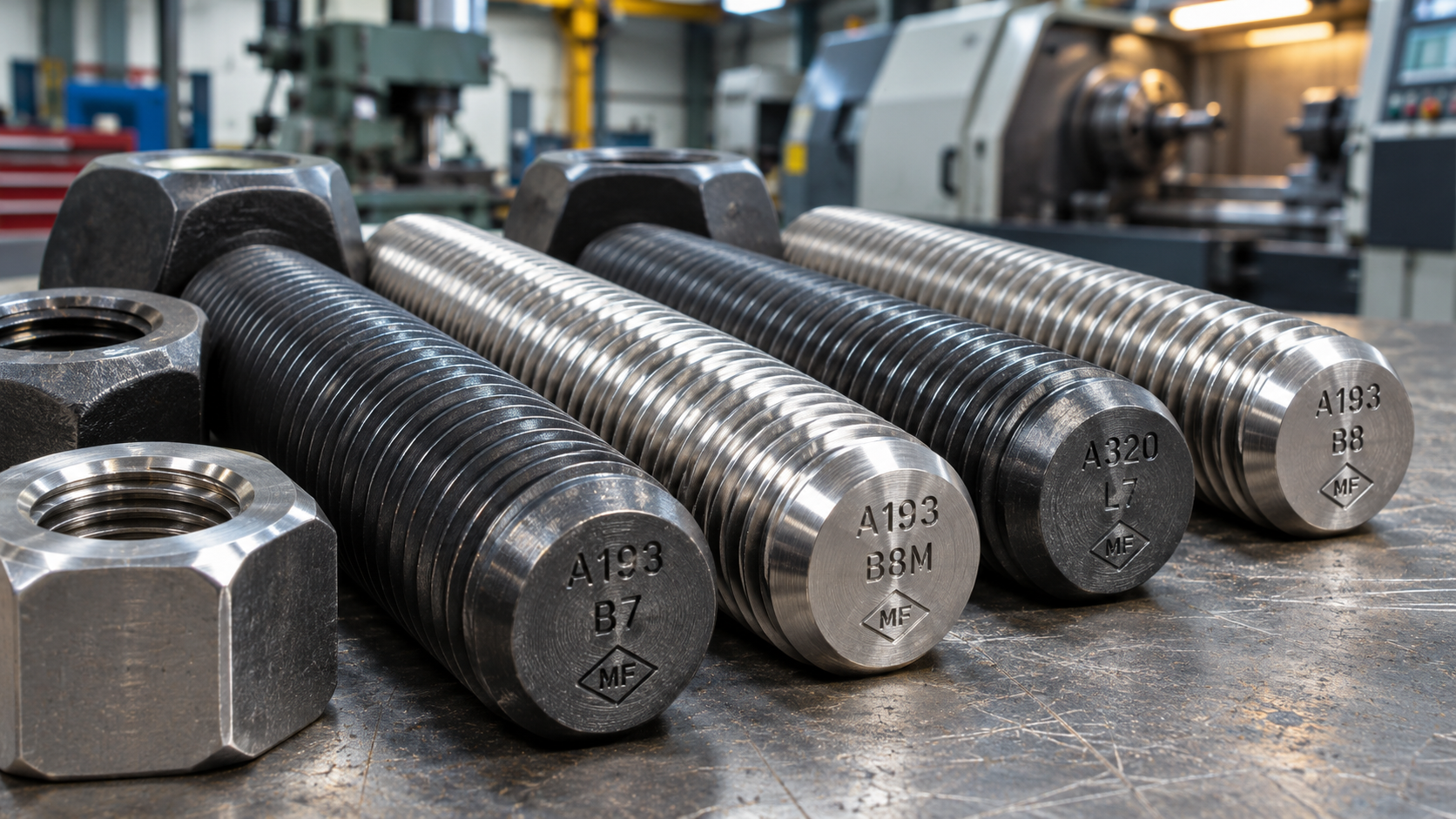
Stud marking comes down to two symbols on one end of the stud: the grade and the manufacturer’s identification. ASTM A193 and A320 studs 3/8 inch and larger need both, and ASTM A194 nuts need the grade and maker’s mark on every nut, whatever the size. The grade symbols tell you what you’re holding: B7 for chromium-moly alloy steel studs under A193, B8M for Type 316 stainless, L7 for low-temperature service, and 2H for the heavy hex nuts that usually go with B7.
Below, we cover where the marks go, the symbols for B7, B7M, B8M, B16 and L7 studs and for 2H and 2HM nuts, and a change in current editions of A193 that’s easy to miss.
Which ASTM Standards Cover Stud and Nut Marks?
Four ASTM standards cover the marks you’ll see on flange studs and nuts:
- ASTM A193. Alloy and stainless steel bolting for high-temperature or high-pressure service, including B7, B7M, B8, B8M and B16.
- ASTM A320. Alloy and stainless steel bolting for low-temperature service, including L7 and L7M.
- ASTM A194. Carbon, alloy and stainless steel nuts for high-pressure or high-temperature bolting, including 2H, 2HM, 7, 7M, 8 and 8M.
- ASTM A962. The common requirements that A193, A320 and A194 product has to meet, including where the marks go. A193’s marking section points to A962 and lists the grade symbols in its own tables.
Where the Marks Go on a Stud
ASTM A962 sets the location. The grade symbol and the manufacturer’s identification go on one end of studs 3/8 inch (10 mm) in diameter and larger. If the end doesn’t have room for both, the grade symbol can go on one end and the maker’s mark on the other. On studs, the marks are stamped into the end.
A few more rules come up on stud orders:
- Studs under 3/8 inch. They aren’t required to carry end marks unless the purchase order calls for marking on all sizes, which A962 covers as a supplementary requirement.
- Bundled and tagged bar. Threaded bar that ships bundled and tagged or boxed doesn’t need marks on each bar. The tag or box carries the grade symbol and the maker’s ID or name.
- Dual-certified product. A stud that meets every requirement of two grades can carry both marks, separated by a slash. A962 gives B7/L7 as the example for a stud that meets both A193 B7 and A320 L7.
- Lot traceability codes. A962 also has a supplementary requirement for marking each piece with a traceability code tied to its lot. The bolting manufacturer defines the code and reports it on the cert.
Grade Marks for Common Stud Grades
B7
B7 is quenched and tempered chromium-molybdenum alloy steel, and it covers most standard flange bolting in oil and gas. Through 2-1/2 inch, it has a 125 ksi minimum tensile strength and a 35 HRC maximum hardness. It’s marked B7, along with the maker’s ID.
B7M
B7M is the same chromium-moly steel as B7, tempered to a lower hardness of 235 HBW maximum, and it’s often specified for sour (H2S) service. Every B7M bolt or stud gets hardness tested.
It’s marked B7M. Older editions of A193 required a line under the symbol to show the stud had been 100% hardness tested, which separated it from B7M made under earlier editions that didn’t require that testing. Current editions no longer require the line but still permit it, so you’ll see B7M both with and without the underline.
B8 and B8M
B8 is Type 304 stainless and B8M is Type 316. Both are Class 1, carbide solution treated, unless the order says otherwise. The class changes the mark:
- Class 1. Marked B8 or B8M.
- Class 2 (strain hardened). Under A193, the grade symbol gets SH added: B8SH or B8MSH. Before SH was added around 2006, Class 2 was marked with an underline alone, so older Class 2 stock may look different.
- Other classes. Classes 1A, 1B, 1C, 1D, 2B and 2C each have their own symbols in A193’s marking table.
B16
B16 is chromium-molybdenum-vanadium alloy steel, and it holds its strength at higher temperatures than B7. It’s marked B16.
L7 and L7M
A320 L7 is the low-temperature counterpart to B7. It’s made from the same AISI 4140, 4142 or 4145 chromium-moly steel family, and each lot is Charpy impact tested at -150°F (-101°C). It’s marked L7.
L7M is the lower-hardness version for sour service at low temperature. It’s impact tested at -100°F (-73°C), every piece is hardness tested, and it’s marked L7M.
A320 adds one marking rule that B7 doesn’t have. Impact tests can be run at a temperature other than the one in A320’s table, as long as it’s at least as low as the intended service temperature. When that happens, the bolting has to be marked to identify the reported test temperature.
Nut Marks: 2H, 2HM and Other A194 Grades
Every A194 nut carries the grade symbol and the manufacturer’s identification, regardless of size, marked on one face. Marking the wrench flats or bearing surfaces isn’t allowed unless the buyer and manufacturer agree to it.
Two suffixes change the symbol. Nuts machined from bar stock add a B, so a 2H nut machined from bar is marked 2HB. Carbide solution treated stainless nuts add an A, as in 8A or 8MA.
- 2H. Quenched and tempered carbon steel heavy hex nuts, and the usual mate for B7 studs. Marked 2H, or 2HB from bar stock.
- 2HM. The same chemistry as 2H with a lower hardness limit, and every nut is hardness tested. It’s the usual mate for B7M. Marked 2HM, or 2HMB from bar stock.
- 7 and 7L. Quenched and tempered alloy steel nuts, used with A320 L7 studs. A320 requires the nuts to meet its impact requirements, and grade 7 nuts that pass the Charpy test under A194 Supplementary Requirement S3 are marked 7L.
- 7M. The lower-hardness alloy nut that goes with L7M, at 235 HBW maximum, with every nut hardness tested.
- 8 and 8M. Type 304 and Type 316 stainless nuts, and the usual mates for B8 and B8M.
A194 dropped the underline requirement for 2HM and 7M too. As with B7M, an underline is still permitted.
Getting the Maker’s Mark Right
Shops that cut studs from threaded rod stamp each stud with the grade symbol and their own identification. Under A962, the certification lists the same grade symbol and manufacturer’s identification, so the marks and the paperwork have to agree. Our guide to what to look for in a stud bolt supplier covers the rest of the paperwork buyers expect.
In the U.S., the Fastener Quality Act can add a step. For fasteners it covers, when the consensus standard requires a manufacturer’s insignia, the manufacturer has to record that insignia with the U.S. Patent and Trademark Office before selling the parts. The act has exemptions, so check with your quality team on whether it applies to your product.
How Stud Ends Get Marked in Production
Some shops still stamp each stud end by hand with letter punches. It works, but hand stamping is less consistent than automated marking, and uneven mark depth leads to readability problems downstream. Our overview of permanent marking on steel compares stamping, dot peen, laser and other methods.
A marking machine takes operator judgment out of the mark. MSI’s MarkMate machines put permanent marks on the ends of studs, bolts and shafts, and most operators are running one within an hour. Each MarkMate is built to order around your part and the marks you need, so the dies are sized to fit.
Two setups cut handling further. The C3A-M ChamferMate handles chamfering and end marking in a single cycle. The AMM-24 AutoMarkMate pairs with the FeedMate cylindrical parts feeder, so studs are fed, marked and unloaded without an operator touching each one.
If studs get hot-dip galvanized, stamp them first. A common sequence is to chamfer and stamp plain studs, then galvanize. Our guide to how stud bolts are made covers the full sequence from threaded rod to a shipped stud.
Marking Machines Built for Stud Shops
MSI builds MarkMate and ChamferMate machines to order in Beaumont, Texas, and our team’s experience in the fastener and stud bolt industries goes back more than 60 years. Send us a sample stud or a drawing showing the marks you need, such as B7, B8M or L7 plus your maker’s mark, and we’ll spec the machine and dies. You can request a quote or see MarkMate and ChamferMate machines at work in our video library.