
 409-842-4404
 What Does an Outside Diameter Chamfer Tool Do?
Key Takeaways
- An outside diameter chamfer tool creates angled edges on cylindrical workpieces, removing burrs and facilitating assembly while reducing stress concentration points.
- These tools improve part functionality through deburring, assembly guidance, and stress distribution while enhancing product aesthetics with professional-looking edges.
- Selection criteria include workpiece material, chamfer angle specifications, production volume requirements, and compatibility with existing machining equipment.
Struggling with sharp edges that create assembly difficulties, safety hazards, and premature component wear? MSI’s precision outside diameter chamfer tools eliminate these costly problems by creating perfectly controlled beveled edges that enhance both functionality and aesthetics of your cylindrical components. Our specialized tooling solutions are engineered to work seamlessly with your existing machining centers, delivering consistent chamfer angles and depths that meet the most demanding specifications in industries from medical device manufacturing to aerospace applications. Manufacturing Solutions Industries provides the technical expertise and custom tooling solutions that transform your edge finishing operations from a time-consuming necessity into a value-added process that enhances product quality and customer satisfaction.
Understanding Outside Diameter Chamfer Tools
An outside diameter chamfer tool is a precision cutting instrument specifically designed to create angled edges, or chamfers, on the external diameter of cylindrical workpieces. These tools effectively remove material at a specified angle (typically between 30 and 60 degrees) from the edge of a cylindrical part, creating a transitional surface between two faces of the workpiece.
The primary components of an outside diameter chamfer tool include:
- Cutting inserts or blades with precise geometries
- Tool holders designed for specific machining operations
- Shank configurations compatible with various machine tools
- Specialized coatings for enhanced tool life and performance
Applications and Benefits
Improved Part Functionality
Outside diameter chamfer tools deliver several functional advantages that make them indispensable in precision manufacturing:
Deburring and Edge Treatment: Sharp edges resulting from machining operations can harbor burrs that compromise part quality and safety. Chamfering effectively removes these imperfections, resulting in smoother, safer components.
Assembly Facilitation: Chamfered edges significantly ease the assembly process, especially for parts that must fit together precisely. The slight bevel created by the chamfer tool guides components into position, reducing the risk of cross-threading or component damage.
Stress Concentration Reduction: Sharp corners can serve as stress concentration points, potentially leading to premature component failure. A properly executed chamfer distributes stress more evenly, enhancing part durability and longevity.
Enhanced Aesthetics and Quality
Beyond functional improvements, outside diameter chamfer tools contribute substantially to the visual appeal and perceived quality of manufactured components:
Professional Appearance: Chamfered edges provide a finished, professional look that distinguishes high-quality manufactured products from those with less attention to detail.
Consistent Edge Treatment: Modern chamfer tools enable manufacturers to achieve uniform edge treatments across production runs, ensuring consistency in both appearance and performance.
Selecting the Right Outside Diameter Chamfer Tool
When determining the appropriate outside diameter chamfer tool for specific applications, manufacturers should consider several key factors:
Material Considerations: The workpiece material significantly influences chamfer tool selection. Different cutting insert geometries and coatings are optimized for specific materials, from aluminum and plastics to hardened steels and exotic alloys.
Chamfer Angle and Size: Applications requiring specific chamfer angles or dimensions necessitate tools designed for those particular specifications. Standard angles include 30°, 45°, and 60°, though custom angles are available for specialized applications.
Production Volume: High-volume production environments benefit from chamfer tools with indexable inserts that can be quickly replaced to minimize downtime. Lower-volume operations might be better served by solid carbide options that provide excellent performance with less frequent tool changes.
Machine Compatibility: Ensuring compatibility between the selected chamfer tool and the available machine tools is essential for achieving optimal results.
Implementation in Modern Manufacturing
In today’s advanced manufacturing environments, outside diameter chamfer tools are implemented across a range of machining operations:
CNC Turning Applications: In CNC turning centers, outside diameter chamfer tools can be programmed for precise chamfer creation as part of multi-operation machining sequences, maximizing efficiency.
Manual Lathe Operations: Even in manual machining environments, specialized chamfer tools enable machinists to create consistent, high-quality chamfers with minimal setup time.
Automation Integration: Modern manufacturing cells often incorporate chamfering operations into automated production sequences, ensuring consistent edge treatment without human intervention.
Hole Chamfering vs Outside Diameter Chamfering
A chamfered hole is a hole whose edge has been cut at an angle, usually 45 degrees, to remove the sharp corner left behind by the drill. Outside diameter chamfering does the same thing to the outer edge of a round part. The geometry is identical. The difference is which edge you are cutting and what tool can reach it.
An OD chamfer tool works on the outside edge of bar, tube, or pipe and cuts inward toward the center. A hole chamfer tool has to enter the bore, so it needs to be small enough to fit and rigid enough not to chatter once it is in there. That constraint is why hole chamfering tends to be slower and fussier than OD chamfering on the same part.
Chamfer Angles for Holes and Outside Diameters
Chamfers get specified two ways. A drawing usually gives the angle of the cut face. Tool catalogs usually give the included angle of the tool, which is double it. Same cut either way, so it helps to know which one you are reading.
- 45 degrees per side, 90 degree included. General deburring, edge breaks, lead-ins, and metric flat head screw seats.
- 41 degrees per side, 82 degree included. Countersinks for US inch flat head machine screws.
- 30 degrees per side, 60 degree included. A longer, shallower lead-in. Also shows up on some pipe and tube end prep.
- 60 degrees per side, 120 degree included. Wide, shallow breaks, plus certain rivet and fastener standards.
If a drawing gives you a chamfer dimension without an angle, it is almost always 45 degrees.
How to Chamfer a Hole
- Deburr first if the drill left a heavy burr. Chamfering over a burr folds it into the edge instead of removing it.
- Pick a tool with an included angle that matches the callout, most often 90 degrees for a 45 degree chamfer per side.
- Run slower than you drilled. Chamfer tools cut on a small portion of the edge and will chatter if you push them.
- Feed to depth, not to time. Chamfer size is usually called out as a width across the face, so check it with a gauge rather than counting handle turns.
- Check the exit side. A through hole needs the chamfer on both ends, and the back side is the one that gets missed.
Tools for Chamfering Holes
- Countersinks cut a cone into the hole edge. Single-flute countersinks chatter less than multi-flute on most materials.
- Chamfer mills run in a mill or machining center and can chamfer a hole edge and a profile in the same setup.
- Deburring blades on a swivel shank pull through the hole and break both edges in one pass. Fast for low volume, inconsistent for production.
- Back chamfer tools reach through the hole and cut the far side without flipping the part.
When a Chamfered Hole Is Required
- Before tapping, so the tap starts square and the first thread does not get damaged
- Where a fastener head or washer has to seat flat against the face
- Where a shaft, pin, or dowel has to enter without shaving the bore
- Anywhere a drawing carries an edge break callout, commonly something like .010 to .020 break all sharp edges
- On parts that get plated or coated, since a sharp edge will not hold coating thickness
Hand Chamfering vs Machine Chamfering
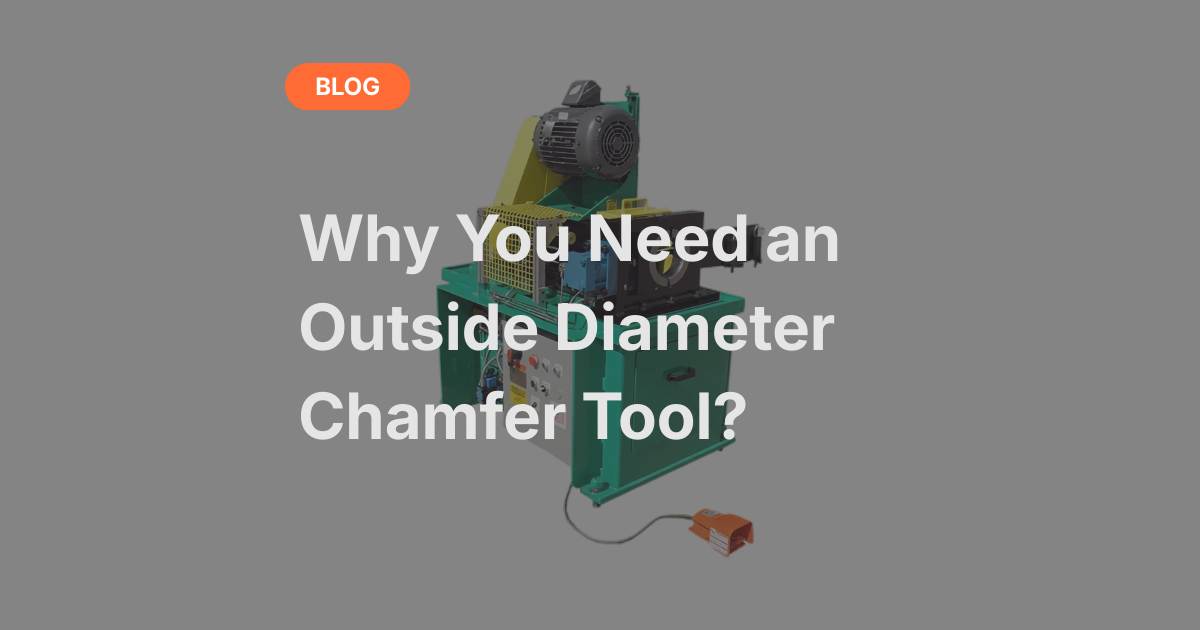
On round parts run in volume, hand chamfering is the bottleneck. The angle and the depth come out different depending on who is holding the tool and how long they have been at it. A chamfering machine holds both to the same dimension on every part because the tooling sets them. A C5A ChamferMate cycles in five to twenty seconds with the operator only loading and unloading, which is usually the difference between chamfering being a step in the process and chamfering being the thing everyone is waiting on.
Manufacturing Solutions Industries: Your Chamfering Expert
At Manufacturing Solutions Industries, Inc. (MSI), our extensive experience with precision machining and tooling solutions positions us as an ideal partner for manufacturers seeking to optimize their chamfering operations. Our expert team provides:
- Comprehensive assessment of chamfering requirements
- Tool selection guidance based on application-specific needs
- Implementation support to ensure optimal performance
- Ongoing technical assistance to maintain production efficiency
We understand that seemingly minor details like edge treatments can have major impacts on product quality, assembly efficiency, and customer satisfaction. Our commitment to precision extends to every aspect of the manufacturing process, including the critical chamfering operations that distinguish exceptional products.
Maximizing Productivity Through Tooling Excellence
The right outside diameter chamfer tool doesn’t just improve product quality—it enhances overall manufacturing efficiency. By investing in high-quality chamfering solutions, manufacturers can:
- Reduce secondary operations like manual deburring
- Decrease assembly time and associated labor costs
- Minimize rework due to assembly issues or cosmetic defects
- Extend product lifecycle through improved stress distribution
These efficiency gains translate directly to improved profitability and competitive advantage in demanding markets where quality and consistency are paramount.
Contact MSI today to discuss your project requirements!