
 409-842-4404
 Manual vs. Automatic Nut Assembly Machines
Key Takeaways
- Manual nut assembly limits scaling through operator fatigue, inconsistent torque, rework, and rising labor cost per unit.
- A powered, semi-automatic station lets one operator match the output of several people working by hand, with consistent results every cycle.
- Automation pays off most in low-mix, high-volume work, while high-mix shops with constant changeovers may still favor manual tools.
- Consolidating benches onto one powered table frees valuable floor space and lowers repetitive-strain injury risk by moving torque into the machine frame.
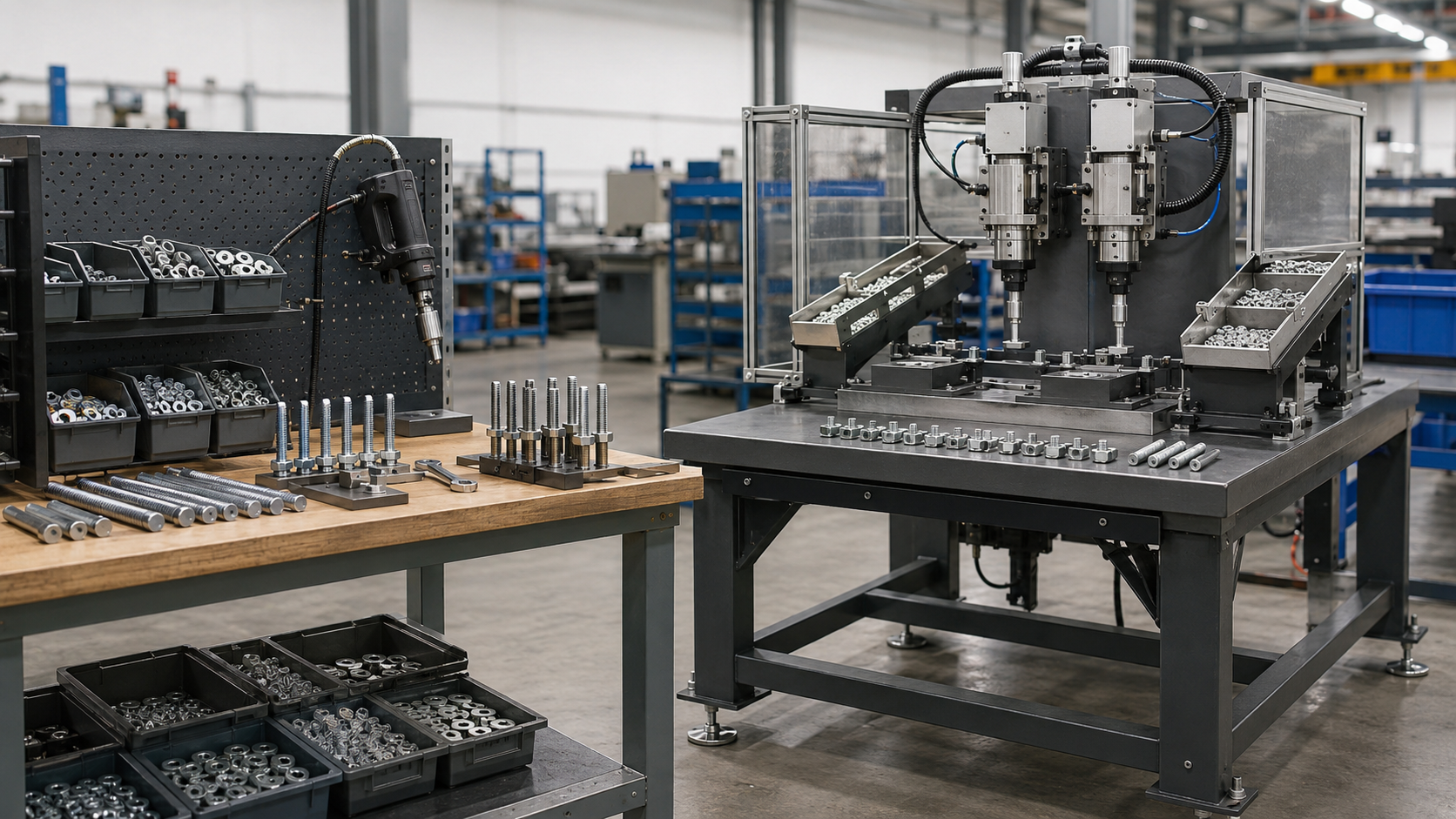
- MSI’s NM-2 NutMate is an operator-loaded, dual-spindle assembly table built in the USA for steady, repeatable fastener assembly.
Most production floors hit a point where adding another person to a manual task stops paying off. On a lot of fastener lines, nut assembly is that task. Deciding when to move from a manual station to a powered nut assembly machine comes down to one question: at what point do your labor costs, quality issues, and volume justify the machine? This guide helps you find that crossover point and weigh throughput, floor space, safety, and return on investment.
When Manual Nut Assembly Starts Slowing You Down
Driving nuts by hand works fine for prototyping and low-volume runs. As demand climbs, the hidden costs show up. The biggest one is rework from cross-threading and missed fasteners, which drives your scrap rate up.
Manual assembly also struggles with consistency. Even with calibrated hand tools, an operator who applies perfect technique at 8:00 in the morning is fighting fatigue by mid-afternoon, which leads to loose connections and stripped threads. That fatigue slows the parts-per-hour rate too, so your schedules get harder to predict and your cost per assembled unit climbs.
Manual, Semi-Automatic, and Fully Automatic: Know the Options
Before you run the numbers, it helps to understand the range of equipment.
- Manual: Operators use handheld nut runners, basic jigs, and loose bins. The operator picks, places, and drives every fastener.
- Fully automatic: Custom robotic cells with feeders and controls that run with little human intervention. They are highly efficient but require heavy capital investment and offer little flexibility when products change.
- Semi-automatic: The practical middle ground for most shops. On a powered assembly table, the operator loads the parts and the machine drives the fasteners to a consistent result. You get much of the speed and repeatability of automation without the cost and rigidity of a full robotic cell.
For a look at where this is all heading, our article on the future of nuts and bolts manufacturing machinery covers how connected equipment is changing the fastener floor.
Comparing Labor, Output, and Changeovers
The main reason shops upgrade is the difference in labor and hourly output. A manual operator can only move so fast, and the pace slides as the shift wears on, while a powered assembly station lets a single operator do the work that used to take several people. The gains come from three places:
- Throughput: One operator on a powered station can match the output of several working by hand.
- Labor reallocation: The people you free up move to higher-value tasks instead of turning nuts all day.
- Consistency: A powered spindle drives to the same result every cycle, which cuts the scrap and rework tied to hand fatigue.
There is a trade-off to weigh. If you run a high-mix, low-volume shop with constant changeovers every few hours, manual workers and hand tools stay competitive, because powered stations need tooling changes and setup when fastener sizes change. Automation pays off best in low-mix, high-volume work where the machine runs on a standardized line.
Get More Out of Your Floor Space
Floor space is expensive, and every square foot should earn its keep. Scaling a manual process means adding benches, lighting, and staging for hardware bins. Consolidating that same output onto a single powered assembly table frees up floor space you can redeploy for other revenue-generating work, which effectively raises your capacity without adding a building.
Safety and Repetitive Strain
Ergonomics hit your operating costs through injuries, turnover, and insurance. Every time a handheld power tool finishes driving a nut, that rotational force goes straight into the operator’s wrist and elbow. Over months and years, that leads to repetitive strain injuries.
The Occupational Safety and Health Administration points to reducing repetitive forceful exertions as a primary way to cut musculoskeletal disorders on the job. A powered assembly machine absorbs the torque into a steel frame instead of a human arm, shifting the operator’s role from exerting force to loading and supervising. That lowers your injury risk, your insurance exposure, and the cost of turnover and medical leave.
Calculating ROI on Nut Assembly Automation
Justifying the spend takes a simple framework. The point that industry groups and trade publications keep making is the same: look past the sticker price to the full return. To estimate your break-even, add up three things:
- Direct labor saved: The fully burdened hourly cost, including benefits and taxes, of the operators you can reassign.
- Increased output value: The financial gain from the higher throughput the machine delivers.
- Reduced scrap: The monthly savings from eliminating cross-threaded parts and warranty claims caused by inconsistent hand torque.
When those savings clear the machine’s cost inside 12 to 18 months, most manufacturers consider it a sound investment. Many powered stations pay back faster than that.
Where the MSI NutMate Fits
If you are looking to bridge the gap between slow hand assembly and an expensive robotic cell, MSI’s NM-2 NutMate Assembly Table is built for exactly that. It uses dual spindles so two operators can work at one station, driving nuts onto studs and bolts to a consistent result before shipment. The operator loads the parts and the powered spindles do the work, which is what keeps hands out of repetitive torque and keeps output steady. Welded 10-gauge construction and hardened steel parts stand up to daily production, and easy changeover keeps you moving between jobs.
For anchor bolts, threaded rod, and other long parts, the Horizontal NutMate uses a foot pedal to assemble nuts and washers quickly. Both machines are built to order in the USA, so you can size them to your parts and your floor. See the full nut assembly lineup for spec sheets and details.
Scale Your Fastener Stations
Identifying the crossover point is step one. Choosing the right equipment is step two. If your volume, labor costs, or scrap rate point toward automation, request a quote or talk to MSI’s team about the NutMate that fits your floor. If you also source raw fasteners, our guide on what to look for in a stud bolt supplier is a useful companion.