
 409-842-4404
 How to Choose a Hydraulic Bar Shear for Fastener Production
Key Takeaways
- A hydraulic bar shear cuts solid round bar in seconds and removes the recurring cost of saw blades, lowering your cost per part.
- Size the machine by material grade and tensile strength, not diameter alone, or you will underpower it and wear it out early.
- Rigid hold-downs, tight blade clearances, and matched tooling produce square, burr-free blanks that feed straight into threading and chamfering.
- Choose the semi-automatic MSI-70 for mixed or moderate volume, or the fully automatic MSI-100 for continuous high-volume runs that need counting and sorting built in.
- A heavy-duty frame, reliable hydraulics, and a domestic builder with accessible parts and support keep the machine running for decades.
Fastener manufacturing runs on output, and output starts at the very first step: cutting raw bar into blanks. If your blanking step is slow, everything downstream waits. The right hydraulic bar shear turns that first step from a constraint into a strength, feeding threading, chamfering, and heading operations without falling behind.
This guide walks through what actually matters when you specify a shear for fastener work: matching capacity to your materials, protecting cut quality for downstream processing, and deciding how much automation your floor needs.
Why a Bar Shear Beats a Saw for High-Volume Blanking
Plenty of shops still cut bar stock with bandsaws or cold saws. Saws give a clean edge, but they are slow, they burn through consumable blades, and they demand constant attention to coolant and swarf. A hydraulic bar shear changes the math. Where a saw takes minutes to work through a heavy bundle, a shear cuts a solid round bar in seconds.
Those seconds add up across a shift. Shearing lets you produce thousands of blanks per shift and drops your cost per part, and cutting the recurring cost of saw blades improves your total cost of ownership. If you are weighing the two methods, our guide on choosing the right saw to cut metal bolts and our overview of how hydraulic metal cutting shears work are good next reads.
Match Tonnage and Capacity to Your Materials
Sizing a round bar cutting machine takes more than knowing your largest diameter. Diameter is only the starting point. The material grade decides the force you actually need.
Cutting mild carbon steel takes far less force than shearing high-tensile alloy, stainless, or heat-treated bar. Every metal has its own yield and tensile strength. If you buy a shear rated for a soft 1-1/2 inch bar and then try to run 1-1/2 inch Grade 8 alloy, you will underpower the machine. That leads to stalled cycles, faster wear on the hydraulics, tooling failure, and downtime.
This is exactly how MSI rates its shears. The MSI-100 Bar Shear cuts 1/2 inch to 1-1/2 inch diameters up to 135,000 pound tensile material, backed by 200,000 pounds of cutting force. When you talk to a builder, give them your exact material specs, maximum diameters, and required speeds so the hydraulic power unit and frame are sized for your real peak loads.
Protect Cut Quality for Downstream Processing
People assume shearing always leaves a flattened or distorted end. A poorly tooled shear does. A properly specified one delivers clean, square cuts that feed straight into the next operation.
Cut quality is not cosmetic in fastener work. A flared, bent, or heavily burred blank will not feed correctly into a thread roller or an automatic chamfering machine. That forces an extra facing or grinding step and erases the speed you gained. To get a square end, look for:
- Premium blade alignment held to tight clearances
- Rigid material hold-downs that clamp the bar against the die just before the blade makes contact
- Closed-profile tooling and dies matched to the exact bar diameter, so cutting force lands on the shear plane
Get those three right and the blank is ready for threading and chamfering with little or no prep.
Decide How Much Automation You Need
Even the fastest shear is limited by how quickly an operator can load bar and clear finished blanks. This is where the choice between MSI’s two shears comes in.
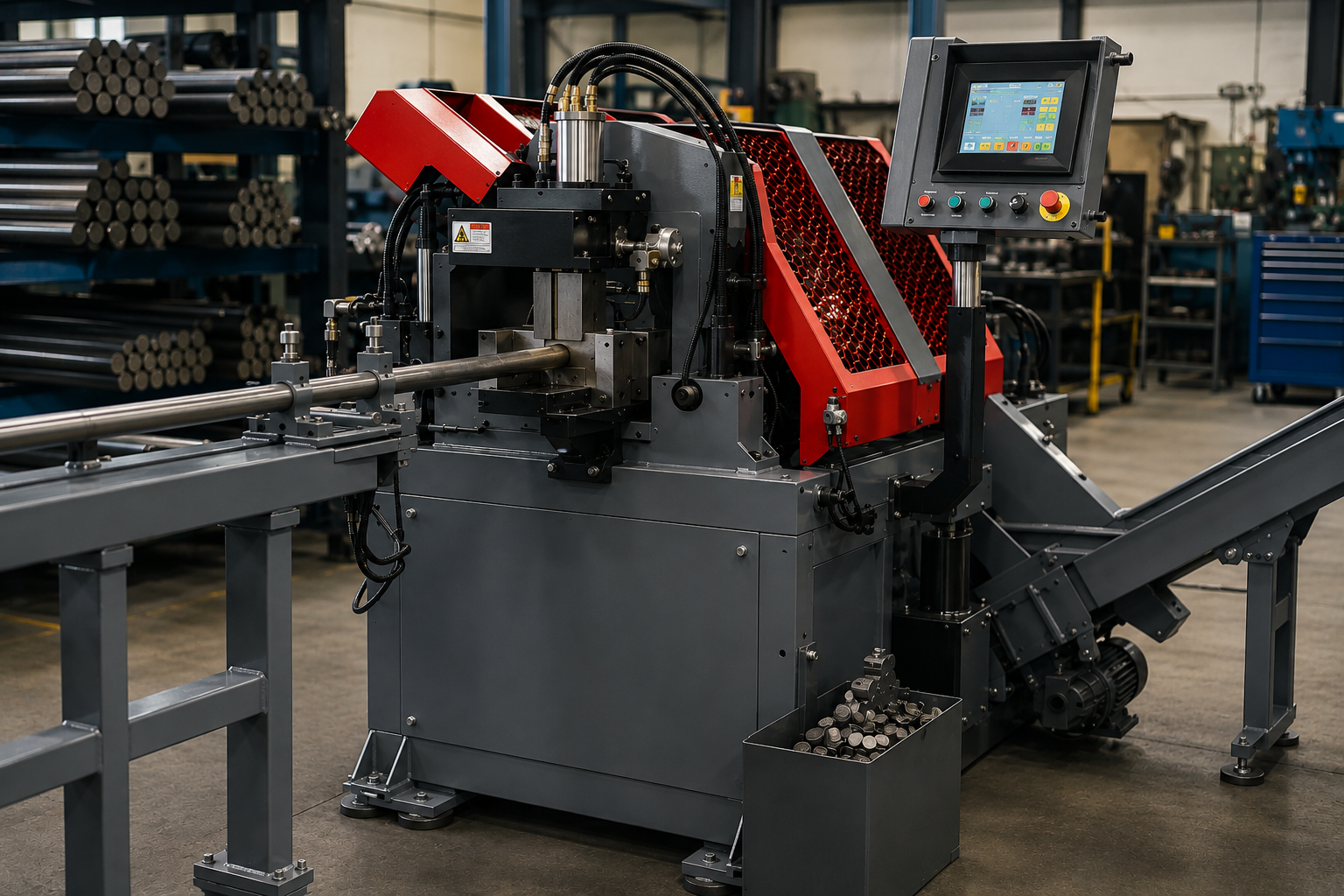
The MSI-70 Bar Shear is a semi-automatic machine. It uses pinch-roller feed for easy operation, with the operator loading the bars. It is a strong fit for shops with steady but moderate volume, or a mix of jobs.
The MSI-100 is the fully automatic option. It handles the cutting cycle and includes crop cutting, sorting of drops, and accurate part counting, so it pulls stock, cuts to length, and sorts with minimal operator oversight. For continuous, high-volume runs on a standardized product, that automation is what recovers labor and keeps output predictable. You can compare both on the hydraulic bar shears page.
Build Quality and the Right Manufacturing Partner
Continuous, multi-shift work is hard on equipment. The shear needs a heavy-duty frame that absorbs repeated shock loads without flexing, plus reliable hydraulics with the reserve capacity and cooling to run all day without overheating.
Off-the-shelf catalog machinery often falls short of high-speed fastener work, and generic distributors rarely understand thread-rolling prep. That is why the builder matters as much as the machine. MSI designs and builds its bar shears in Beaumont, Texas, and can tailor a machine to your parts and your floor layout, from custom tooling to compact sizing. Buying from a domestic builder also means parts, tooling, and real-person support are easy to reach when you need them.
Talk Through Your Application
The best shear is the one matched to your materials, your volume, and your floor. Send MSI your parts and specifications and their engineers will help you spec the right machine. Request a quote or talk to an expert to build the cutting solution your production floor needs, and see the full MSI machine lineup for the operations that come after the cut.