
 409-842-4404
 How Automatic Parts Feeders Fix Production Bottlenecks
Key Takeaways
- Machine idle time usually comes from starving the line, where manual loading cannot keep pace with the machine’s cycle time.
- Manual loading adds fatigue and misorientation risk, which can crash machines, damage tooling, and lower overall equipment effectiveness.
- For heavy, oily, or large cylindrical parts, a mechanical step feeder runs quieter and more reliably than a vibratory bowl.
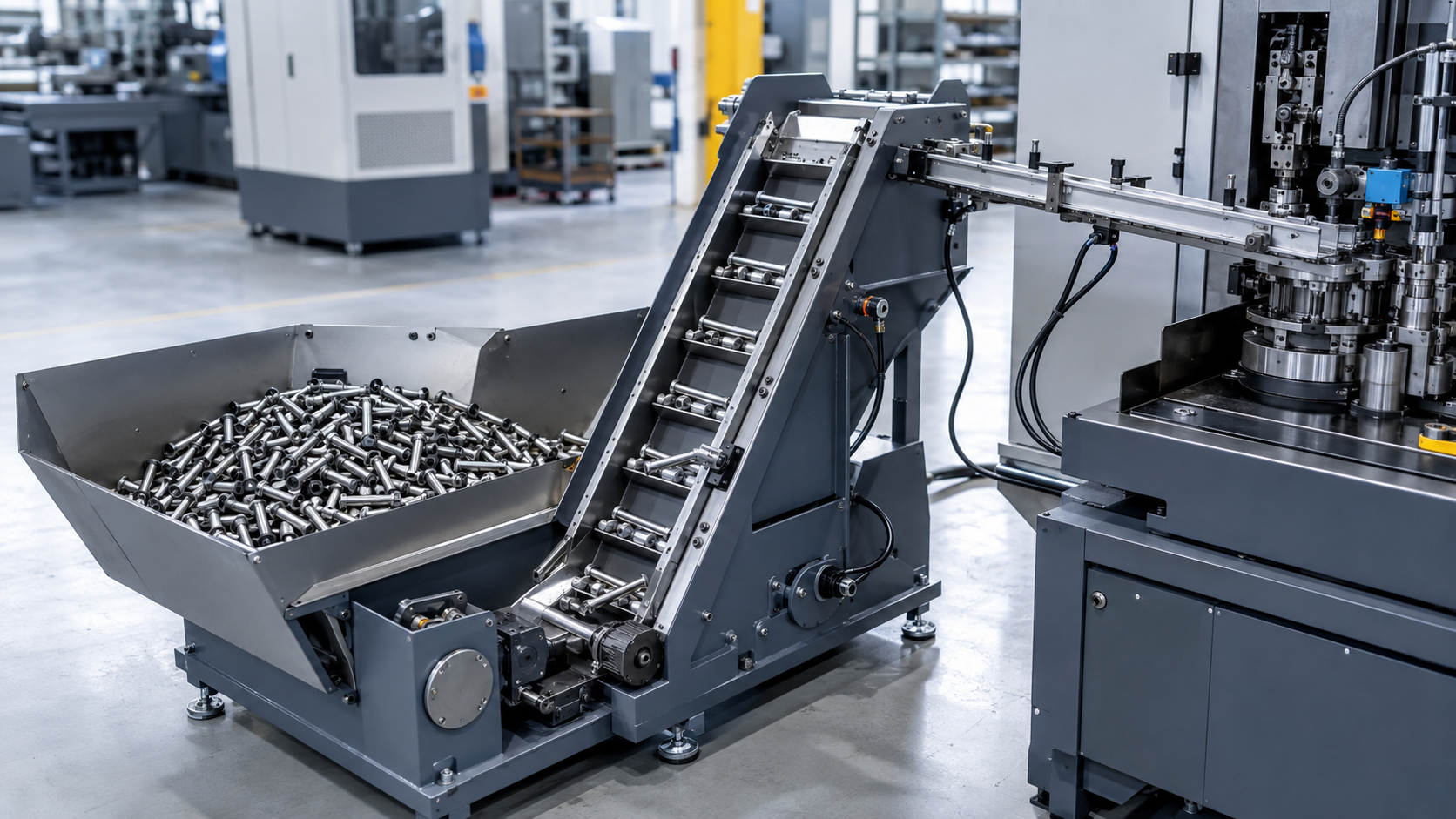
- The MSI FeedMate feeds cylindrical parts like bolts, studs, and round bar into threading, chamfering, and grinding operations, and pairs with other MSI machines.
- Automating the feed recovers lost production hours, cuts scrap, and lets you move operators to higher-value work.
A fast machine is only as fast as the parts reaching it. When your loading method cannot keep pace with the cutting or assembly cycle, the machine sits idle and your throughput drops. An automatic parts feeder fixes that by delivering a steady, correctly oriented supply of parts, so the primary machine runs at the speed it was built for.
Plant managers and production engineers spend heavily on high-speed equipment, then watch it wait on the next part. Solving that specific mismatch means moving away from inconsistent manual loading and adding a feeder that keeps the flow continuous.
The Hidden Bottleneck: Your Parts Feeding Process
Bottlenecks rarely announce themselves. They bleed efficiency through micro-stops and fractional delays. In lean terms, this is called starving the line, and it happens when your primary machine’s cycle time is faster than your part-delivery speed.
The math is simple. If your machine can finish a part every five seconds but your loading method delivers one every eight seconds, your true rate is capped at eight seconds, and the machine spends nearly forty percent of its life waiting. That gap is why a facility misses its overall equipment effectiveness targets. Closing it means bridging bulk part storage and the precise, timed presentation the machine needs.
Why Manual Loading Caps Your Output
Asking operators to hand-load high-speed equipment puts human variables into a system that needs consistency. Fatigue and natural changes in pace make it impossible to match the steady rhythm of modern machinery.
Speed is not the only issue. Manual loading brings the risk of misorientation. A tired operator is more likely to load a part backward or upside down, and in heavy work, feeding a threaded stud or a heavy blank wrong can crash a press or shatter tooling. That means downtime, repair costs, and scrap. Even minor errors cause jams, and every jam forces someone to stop, clear it, and reset. Each intervention drags down your effectiveness and drives up your cost per part.
How an Automatic Parts Feeder Synchronizes the Line
An automatic parts feeder removes those variables by guaranteeing a constant, correctly oriented supply. Instead of treating loading as a separate task, a feeding system ties into the primary machine’s controls so the two work as one loop.
The mechanics rely on precise escapements and sensors. The escapement isolates a single part from the bulk supply and releases it exactly when the machine is ready, while proximity and vision sensors confirm the part is present and correctly oriented before the handoff. If a part is misaligned, the system rejects and recirculates it without stopping the main cycle. Automating this frees your operators from repetitive feeding so they can move to higher-value work like quality checks, supervision, or preventive maintenance.
Step Feeders vs. Vibratory Bowls for Heavy Parts
When shops start researching feeders, they usually get pointed toward vibratory bowl feeders. Bowls are everywhere, but they are built for small, light components. They move parts up a spiral track using vibration and gravity, which works for tiny fasteners and struggles with heavier stock.
A step feeder is the stronger choice for larger, heavier, or awkward cylindrical parts. Instead of vibration, it uses mechanical lifting to elevate parts from a hopper and cascade them down an oriented track. That mechanical action is gentler on parts and avoids the scratching common with bowls. It also handles oily and coolant-covered parts that make bowls lose traction, and its floor-level hopper means no climbing a ladder with a heavy bucket to refill a tall bowl. Our guide to step feeder design fundamentals goes deeper on how these systems are built for reliable material handling.
The FeedMate Cylindrical Parts Feeder from MSI
To solve heavy-duty feeding, MSI built the FeedMate Cylindrical Parts Feeder. It is engineered to keep a steady, oriented supply of cylindrical parts moving to your primary machine, so a fast machine stops waiting on loading.
The FeedMate is built for demanding cylindrical stock, from bolts and studs to round bar, and it feeds those parts into secondary operations like threading rollers, chamfering machines, and cylindrical grinders. Because MSI designs its equipment to work together, the FeedMate pairs cleanly with other machines on the floor, including the ChamferMate line, so you can build a continuous-flow cell without integration headaches. MSI also builds custom tooling to your part geometry, and every machine is made in the USA. For a broader view of where connected feeding fits, see our look at the future of nuts and bolts manufacturing machinery.
The Payoff: Recovered Uptime and Reallocated Labor
The case for a feeder gets clear when you count recovered machine time and freed-up labor. Say an operator hand-loads at 8 parts per minute while the machine can finish 12. That is 4 lost parts every minute, 240 an hour, and close to 2,000 units over an eight-hour shift, gone simply because the machine was starved.
A continuous feeder recovers that capacity so the machine runs at its true speed. You also stop dedicating a full-time operator to a single loading station, and you cut the scrap and tooling damage caused by orientation errors. Between those savings, a heavy-duty feeder often pays for itself within the first few months.
Close the Gap on Your Line
Ending bottlenecks means moving away from manual loading and mismatched feeders. A heavy-duty cylindrical parts feeder synchronizes your cycle times, protects your tooling, and keeps the flow continuous. Request a quote or talk with MSI’s team about matching a FeedMate to your line speed and parts, and see the full MSI machine lineup for the operations it feeds.